Fourfold
The Setup
You are shown a picture. You produce it by dropping the fewest possible grains of sand.
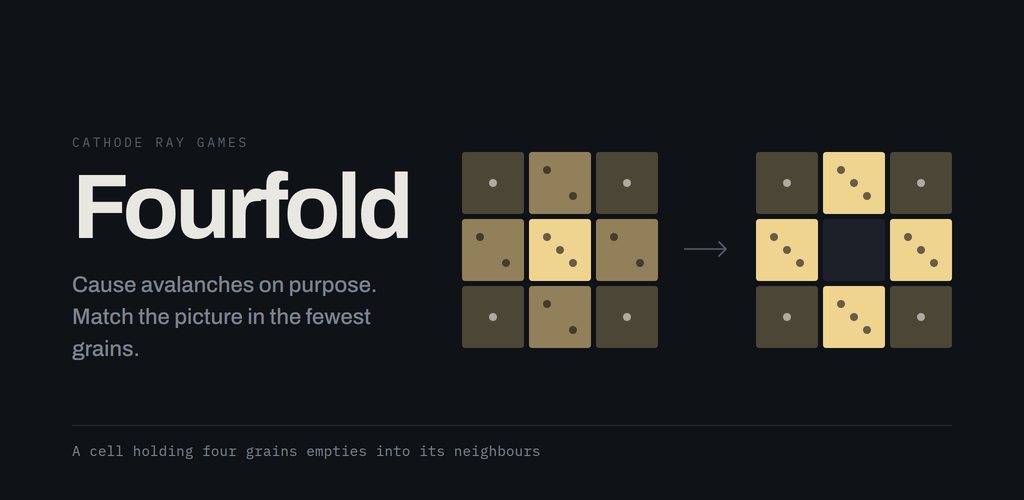
Every cell on the board holds up to three grains. Put a fourth in and the cell empties, pushing one grain into each of its four neighbours. That can set off the neighbours, and theirs, and theirs. Grains that reach the edge fall off and are gone.
That is the whole ruleset. Everything else follows from it.
The Mathematics
Fourfold runs on the Abelian sandpile model (Bak, Tang and Wiesenfeld, 1987; Dhar, 1990). Four results from that literature are load-bearing, and the test suite checks each one on every build rather than taking it on trust.
- Order does not matter. The settled board is the same whichever unstable cell resolves first. Undo is therefore exact, and no board can be put into a state it cannot come back from.
- Every target is reachable. Legal boards form a finite abelian group and single taps generate all of it, so solvability holds for every board rather than being established by testing.
- The shortest solution is unique. Verified for all 230 shipped boards rather than sampled. Each has exactly one shortest solution, and the build re-checks every one.
- Scoring reduces to one quantity. Your total taps equal the grains you need to gain plus the grains you lose off the edge. The first term is fixed by the board, so the only thing you control is waste. Avalanches in the middle cost nothing. Avalanches at the boundary leak.
The Modes
Restore. The campaign: 230 boards across seven chapters. Square grids, grids with holes, hexagonal boards where a cell holds five grains, and toroidal boards that wrap around a single drain.
Daily. One board a day, the same board for everyone, generated on the device. The generator and the random number source are bit-identical across the web and Android builds, so both produce the same puzzle without fetching anything.
Cascade. Endless. Drop grains on a critical pile. Avalanche sizes follow a power law because that is what a self-organised critical system does on its own, not because they were tuned to.
Atelier. Draw a board of any shape and compute the identity element of its sandpile group, along with the group's order. There is no known closed formula for constructing one. Plates can be saved to a gallery.
Journal. Eight techniques, named after the underlying mathematics, unlocked by using them rather than by reading about them.
Pace and Accessibility
There are no timers, no fail state and no energy meter. Nothing is lost by leaving a board unfinished for a week.
Grain height is shown by fill and by pip count, never by colour alone, and pip colour is picked against each cell's own luminance so the count stays legible at every step of both ramps. Reduced motion is honoured from the system setting and from an in-game switch. Light and dark both ship at full quality. The web board is keyboard-navigable with a live region announcing cell state, and touch targets are at least 44px.
The Sound
Cascade audio is granular and synthesised from the simulation rather than triggered from a bank of samples. One topple is a grain hitting paper, a nine-hundred cell cascade is a landslide, and everything in between is the same source scaled, so what you hear is always proportionate to what happened.
Two ambient pieces sit underneath, off by default: Tiled Hours on a board and The Unlatched Door in the menus. Both duck when an avalanche has real mass.
Permissions and Data
The Android build does not request the INTERNET permission, so Android prevents it from opening a network connection at all. The permission list is visible under Settings, Apps, Fourfold, Permissions.
No accounts, no analytics, no advertising, no third-party SDKs. Everything the game remembers stays on the device, and the daily puzzle is generated there rather than downloaded.
Price and Availability
Web. A free demo, up now at fourfold.cathoderaygames.com. It installs as a PWA and runs with the network off. The web build stays a demo. It is there to let you find out whether you like the game before paying for it.
Android. The full game. $3.99 once, on Google Play from 10 September 2026. No advertising, no in-app purchases, no subscription and nothing to unlock. It adds haptics scaled to cascade size.
iOS. Not planned yet. If enough people buy it on Android, it will be.
Both builds share one engine and one design system. The engine exists twice, in TypeScript and in Kotlin, and the test suite pins the two to bit-identical output.
Key Art
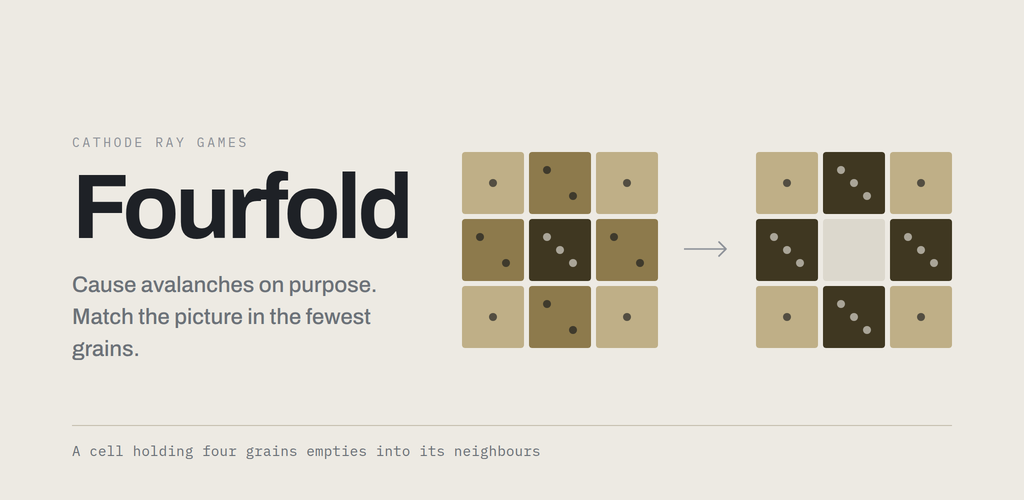
The key art is the rule itself. A cell holding four grains empties into its neighbours, which is the only mechanic in the game. Dark and light versions of the game ship at equal quality, so the key art does too.
Reading
- Bak, Tang & Wiesenfeld (1987). Self-organized criticality: an explanation of 1/f noise. Phys. Rev. Lett. 59, 381.
- Dhar (1990). Self-organised critical state of sandpile automaton models. Phys. Rev. Lett. 64, 1613.
- Majumdar & Dhar (1992). Equivalence between the Abelian sandpile model and the q → 0 limit of the Potts model.
- Moore & Nilsson (1999). The computational complexity of sandpiles. J. Stat. Phys. 96, 205.
- Lang & Shkolnikov (2019). Harmonic dynamics of the abelian sandpile. PNAS.